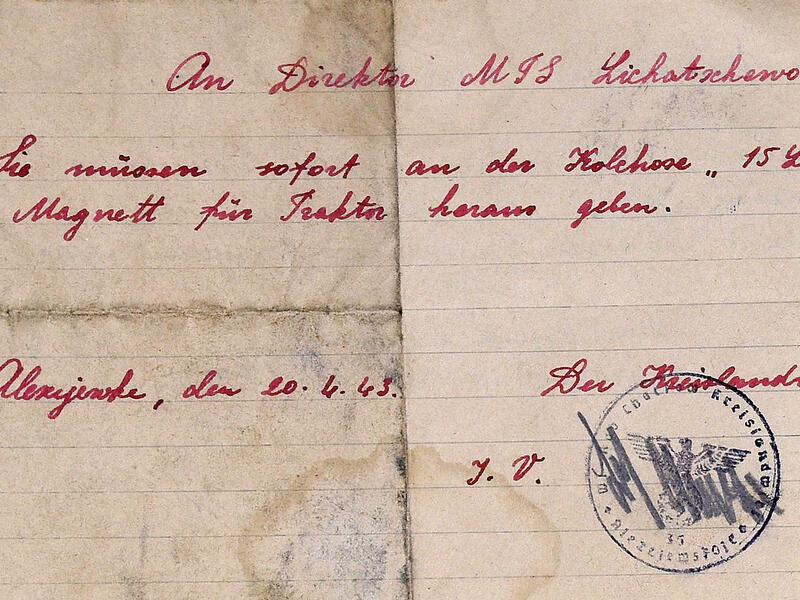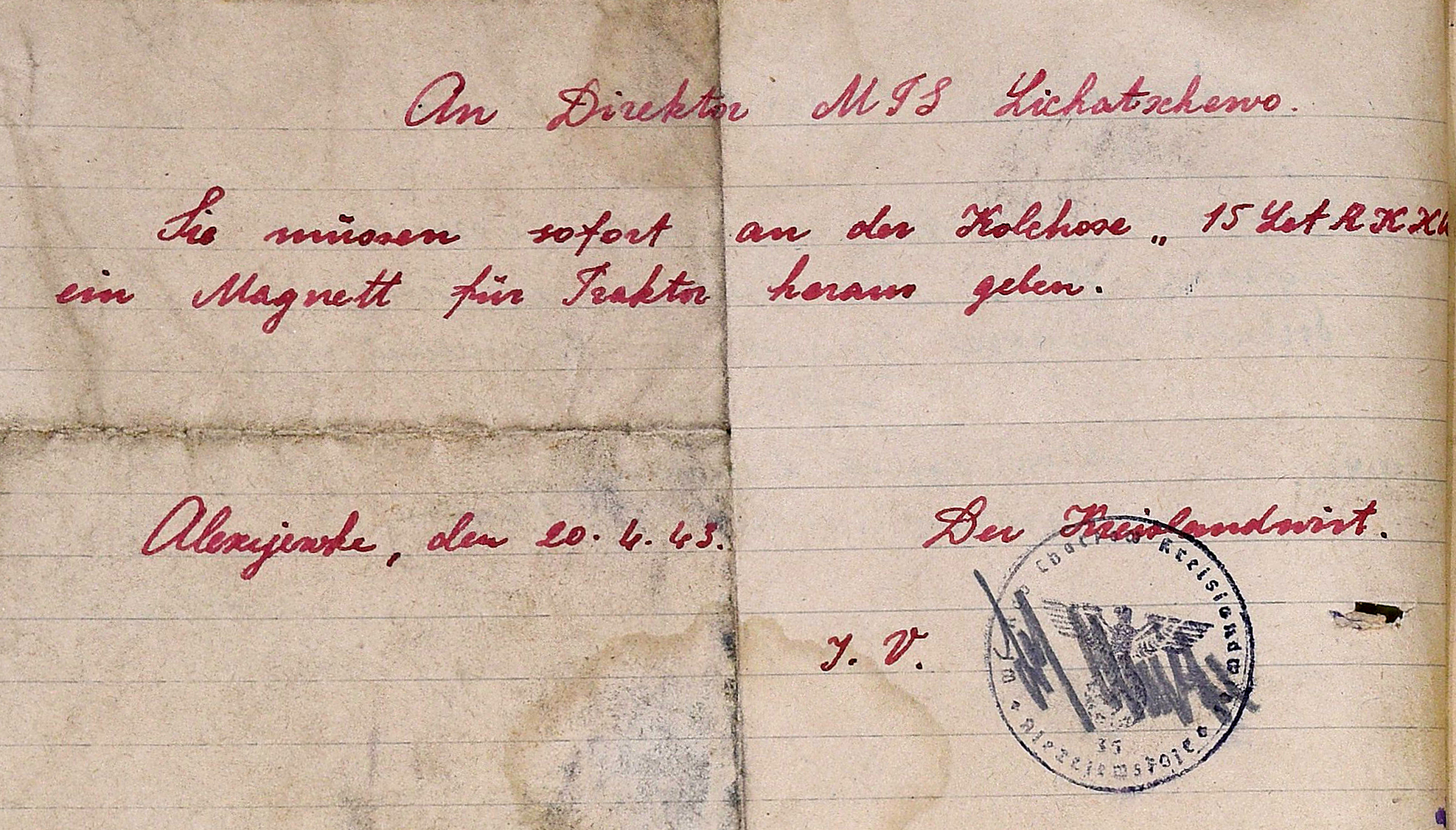
Lykhachove Machine-Tractor Station During the Years of Occupation
© Andrii Paramonov (Kharkiv)
The history of civil institutions in Kharkiv region during the years of the Nazi occupation remains little studied to this day. As a rule, local historians and researchers focus primarily on the period of military operations, as well as the repressions of the occupying authorities. To some extent, industry, the construction of a new civil society, and political and social reforms are being studied, but the agriculture of this period has largely remained outside the scope of researchers. While preparing a book on the history of the town of Pervomaiskyi, I managed to examine the archival fund of the Lykhachove Machine and Tractor Station (MTS) from the occupation period, which allowed me to prepare a separate chapter in the book and this publication.
The settlement near Lykhachove railway station of the Southern Railway was founded back in 1869. In 1927, it was granted the status of an urban-type settlement with a land area of 46 hectares. By that time, there were already 85 households[1]. Administratively, before the revolution, it was a part of the Zmiiv County of Kharkiv Governorate, while during Soviet period, it belonged to the Oleksiivskyi District in Kharkiv region. After World War II, Lykhachove became the center of the settlement council, and essentially the district center. On June 24, 1952, the settlement of Lykhachove was renamed the settlement of Pervomaiskyi, a name it still bears today as a town, and in 1963, the Oleksiivskyi District was renamed the Pervomaisky District in the Kharkiv Region.
The decision to construct the MTS near the Lykhachove railway station was made on August 15, 1929, with 30 dessiatines of land allocated for its premises[2]. On March 3, 1930, the Kharkiv District Executive Committee recommended naming it after Comrade Postyshev[3]. However, it was later simply called the Lykhachove MTS. The construction of the MTS began in December 1929, and by March 18, 1930, the MTS was tasked with cultivating 17,356 dessiatines of arable land across 16 settlements and 16 artels. At that time, its staff consisted of a director, a deputy director, 3 agronomists, a senior engineer, 9 senior tractor operators, 129 tractor operators, and 16 agricultural representatives. By the start of its operations, the MTS possessed 8 tractors, 45 plows, 26 plow-seeders, 58 seed drills, 150 zigzag harrows, and 95 cultivators[4].
In the same year, 1930, the MTS received 42 new Fordson tractors, which had first entered production in the United States of America in 1917. The Fordson was an inexpensive, small, and mechanically simple 20-horsepower tractor, marketed through Ford’s automotive dealer network. Between 1921 and 1927, the Soviet Union purchased 25,000 of these tractors, and by 1927 they made up 85% of the Soviet Union's tractor fleet. An additional 36,000 Fordson units were manufactured under American license in Leningrad at the Chervonyi Putilovets plant between 1924 and 1931, though under the name Fordson-Putilovets. Another tractor variant produced under license in Leningrad could have been the Universal, which was also based on an American design. Later, the Lykhachove MTS, alongside the neighboring Beretska and Bieliaievska MTS, was supplied with tractors manufactured at the Kharkiv Tractor Plant.
By June 22, 1930, MTS was serving 23 collective farms and artels across an area of 8,000 hectares, conducting plowing, cultivation, harrowing, and sowing operations. In that same year, 1930, a club, a library, and a canteen were opened at the MTS.
In addition to providing services to the artels and collective farms of the Oleksiivskyi District, the Lykhachove MTS essentially became an educational institution as well, where more than 200 tractor drivers, bookkeepers, and other agricultural specialists were trained annually. Furthermore, its training courses prepared over 300 individuals in other essential occupations every year.
The German occupation of the former Oleksiivskyi District began on October 20, 1941, but the occupying authorities managed to resume operations at the Lykhachove MTS only in June 1942, once this territory found itself in their deep rear. It has not yet been possible to detail the information for this specific period, as the documentary sources have been lost. When the Oleksiivskyi District was briefly liberated from the Nazi control in February–March 1943, the MTS ceased operations. Part of the equipment was moved by the Germans to Pavlohrad, and the station’s management, headed by the MTS director Mykola Zakharovych Shkola, relocated there as well. MTS employees were also evacuated by the Germans, particularly mechanics and tractor drivers, as well as young men in general. This spared them from being conscripted into the ranks of the Red Army.
When the Germans returned at the end of March 1943, they launched intensive preparations across Kharkiv region to prepare for the spring sowing campaign. By that time, nothing but bare walls remained of the Lykhachove Machine and Tractor Station. What mattered most to the German occupation authorities, however, was that they had retained a core workforce of 30 employees, headed by Petro Vasylovych Hubar, a former rank-and-file tractor operator with primary education. The workforce consisted mainly of mechanics, combine harvester operators, and tractor operators, supplemented by a blacksmith, carpenters, joiners, and general laborers[5]. With the beginning of fieldwork, the number of tractor operators increased, and brigade leaders were also added to the staff.
On average, the MTS workers received 500–600 rubles per month in cash, alongside a ration. In May, for instance, this included one loaf of baked bread, as well as several kilograms of millet and corn. With the start of fieldwork, most MTS employees became entitled to an increased ration, particularly those who operated high-capacity tractors and achieved high levels of productivity. Another form of compensation was the accumulation of labor-day credits, which entitled the MTS workers to a certain amount of grain upon completion of the harvest. However, whether they managed to receive it remains unknown.
After the resumption of the MTS operations in April 1943, it became apparent that there was a catastrophic shortage of small tools. Mechanics, quite literally inspired by the high demand for their skilled labor, fashioned their own sets of wrenches, manufactured dies and taps, and gathered tools: some from their personal reserves, others purchasing them out of pocket. For instance, a mechanic Hubar provided a pair of pliers, a vise was purchased from a citizen named Maltsev, and a hand drill was acquired from an unidentified individual. Every single part or tool was accepted by a mechanic or a master foreman against a signed receipt.
During the very first weeks of operation, equipment and machine tools began arriving from Pavlohrad. On April 23, 1943, plows for the Lykhachove MTS arrived at the Lykhachove railway station, followed later by brand-new German cultivators. The schedule of the train carrying the cultivators from Kharkiv shows that they were delivered not only to the Lykhachove settlement but also to other stations. The total number of German cultivators received in the oblast reached 600 units.
By early May 1943, the MTS already possessed 19 tractors, eight of which were undergoing repairs. The tractors were exclusively crawler models: 14 ChTZ S-60 machines, 4 crawler KhTZ-NATI units, and 1 crawler KhTZ-T2G. The machines exhibited a wear rate of about 20%. Later, however, old wheeled tractor models, such as SKhTZ 15/30 and Universal-2, which had an 80% wear rate, began arriving at the Lykhachove MTS. Interestingly, pre-war Soviet tractors lacked electric starters. They were all started manually with a hand crank. By order of the occupying authorities, attempts were made to install electric starters on heavy ChTZ “Stalinets” S-60 and S-65 tractors. Unfortunately, the records do not specify exactly what kinds of starters were used or the machinery from which they were taken.
In addition to the tractors, seven combine harvesters returned to the MTS: four Kommunar machines and three Stalinets machines, though with up to 90% wear and tear, making their repair an incredibly arduous task. The station also possessed one GAZ-AA truck (known as the Polutorka or 1.5-ton truck), which similarly required repairs. The agricultural implements available at MTS included nine cultivators, five K412D plows, one three-bottom plow, two 725P stubble plows, and 2 MO900 threshing machines[6].
The repairs conducted at the MTS were inspected by the district administration. A technician from this administration, a German named Schweren, would personally arrive to inspect the repairs of the machinery or engines. His demands for precision and cleanliness in the workplace were enforced through severe disciplinary actions and fines. To maximize the effectiveness of his methods, Schweren circulated the results of his inspections to all MTS units across the Kharkiv region, ensuring that his enforcement measures and requirements became widely known and implemented.
Fuel for the Lykhachove MTS was supplied through the Oleksiivka commandant's office, which also monitored its consumption. This control was evidently strict and multi-level, yet simultaneously burdensome for the management, given that several types of fuel were in use, and both the amount of machinery and the size of the workforce were expanding. A separate quantity of fuel and a designated responsible person were assigned to each machine and type of work. For instance, the following amounts were allocated in July 1943: 604+16 kg of gasoline, 18,481 kg of tractor oil, 11,133 kg of diesel fuel, and 1,615 kg of motor oil[7]. The bulk of this was spent on harvesting campaigns and plowing operations, with additional quantities used for cleaning components during repairs and other agricultural tasks.
By July 1943, the Lykhachove MTS already possessed 28 tractors. The majority were crawler models, including 12 ChTZ S-60 machines, one S-65, and five KhTZ-NATI units, alongside four "Universal-2" wheeled tractors and six SKhTZ 15/30 wheeled machines. The number of combine harvesters had also increased, reaching nine Kommunar and four Stalinets machines.
The Lykhachove MTS serviced 27 former collective farms in the Oleksiivskyi District, which had been converted into community farms. Interestingly, they retained the names they had held prior to the war. Apparently, this was of absolutely no consequence to the occupying authorities, who perhaps intended to address the matter at a later date. For instance, within the Oleksiivka Rural Administration, we find the communities “Path of Communism”, “15th Anniversary of the Red Army”, “Ray of New Life”, “March 8th”, “Paris Commune”, and “Red Cossacks”; under the Syvaska Rural Administration – “Karl Marx”; under the Dmytrivka Rural Administration – “Named after Voroshilov”; under the Verkhnya Orel Rural Administration – “Red Path”, “Named after Kirov”, and “12th Anniversary of October”; and under the Rzhavska Rural Administration – “Named after Lenin” and “7th Congress of Soviets”[8]. The documentation was kept in Ukrainian and Russian, but it was also duplicated in German for the district administration.
Part of the tractors from the Lykhachove MTS went to the communities of the Oleksiivskyi District under certificates confirming their full operational condition, and their own tractor drivers worked on them. However, the act of full readiness did not guarantee that the tractor would not break down. As an example, a crawler tractor, the KhTZ-NATI, operated from August 1 to August 7, 1943, cultivating fallow land in the "Named after Voroshilov” community. During these days it cultivated 53 hectares of land, used 309 kg of kerosene, 13 kg of motor oil, and 3 kg of gasoline. Two tractor drivers worked a combined total of 50 hours, spending one entire 24-hour period on repairs, along with an unspecified number of hours repairing the tractor on another day.
The combine harvesters operated more or less without breakdowns. For instance, during the harvesting of winter wheat and winter rye in the “12th Anniversary of October” community, a Kommunar combine harvested crops across an area of 132 hectares between August 1 and August 20, 1943, consuming 610 kg of diesel fuel and 181 kg of oil without any downtime for repairs.
The Lykhachove MTS and the communities of the Oleksiivskyi District managed to harvest the early grain crops before the final liberation from the Nazis. They would have to harvest sunflowers and corn under their restored status as collective farms, but entirely by hand, since the German occupying authorities had evacuated not only the machinery and machine tools from the MTS, but also all tractors, combines, and agricultural implements from both the MTS and the communal estates. The entire harvest was also confiscated and moved out. The evacuation proceeded quite rapidly, with the primary equipment and machinery being removed on August 28–29, 1943. Due to a shortage of empty railcars, on September 1, 1943, only 12 two-bottom plows and 12 reapers were loaded onto the train[9]. The following day, the echelons were loaded with 79 cultivators, 10 self-rake reapers, seven mowing machines, and 76 plows. On September 3, 1943, another 62 cultivators, seven self-rake reapers, and 120 plows were loaded. Consequently, when the territory of the Oleksiivskyi District was liberated on September 16, 1943, it was left with absolutely nothing.
[1] State Archive of Kharkiv Oblast, hereinafter SAKO. Fund R-1573, Inventory 1, File 65. – Sheet 19.
[2] SAKO. Fund R-845, Inventory 3, File 21143. – Sheet 252.
[3] SAKO. Fund R-845, Inventory 3, File 2934. – Sheet 114.
[4] SAKO. Fund R-845, Inventory 3, File 3209. – Sheets 91-98.
[5] SAKO. Fund R-3047, Inventory 1, File 3. – Sheet 1.
[6] SAKO. Fund R-3047, Inventory 1, File 8. – Sheet 31.
[7] SAKO. Fund R-3047, Inventory 1, File 7. – Sheet 11.
[8] SAKO. Fund R-3047, Inventory 1, File 5. – Sheet 15.
[9] SAKO. Fund R-3047, Inventory 1, File 6. – Sheet 7.