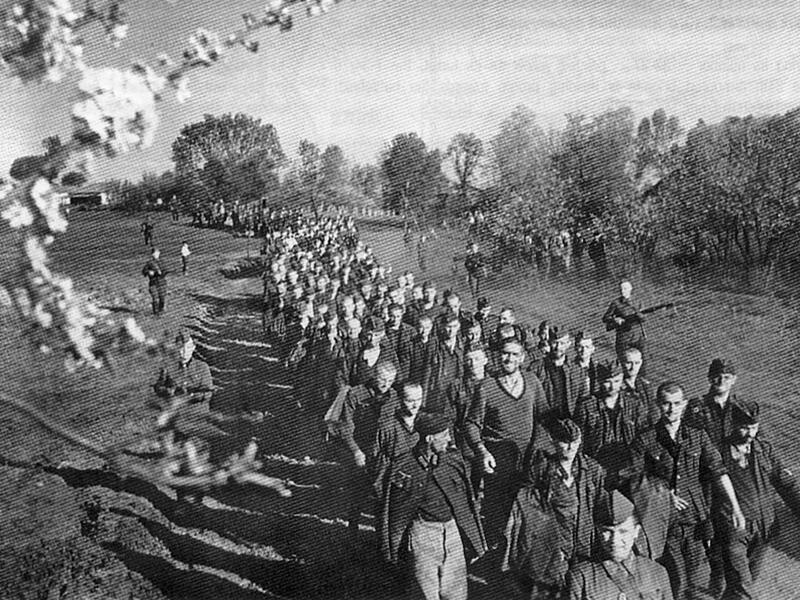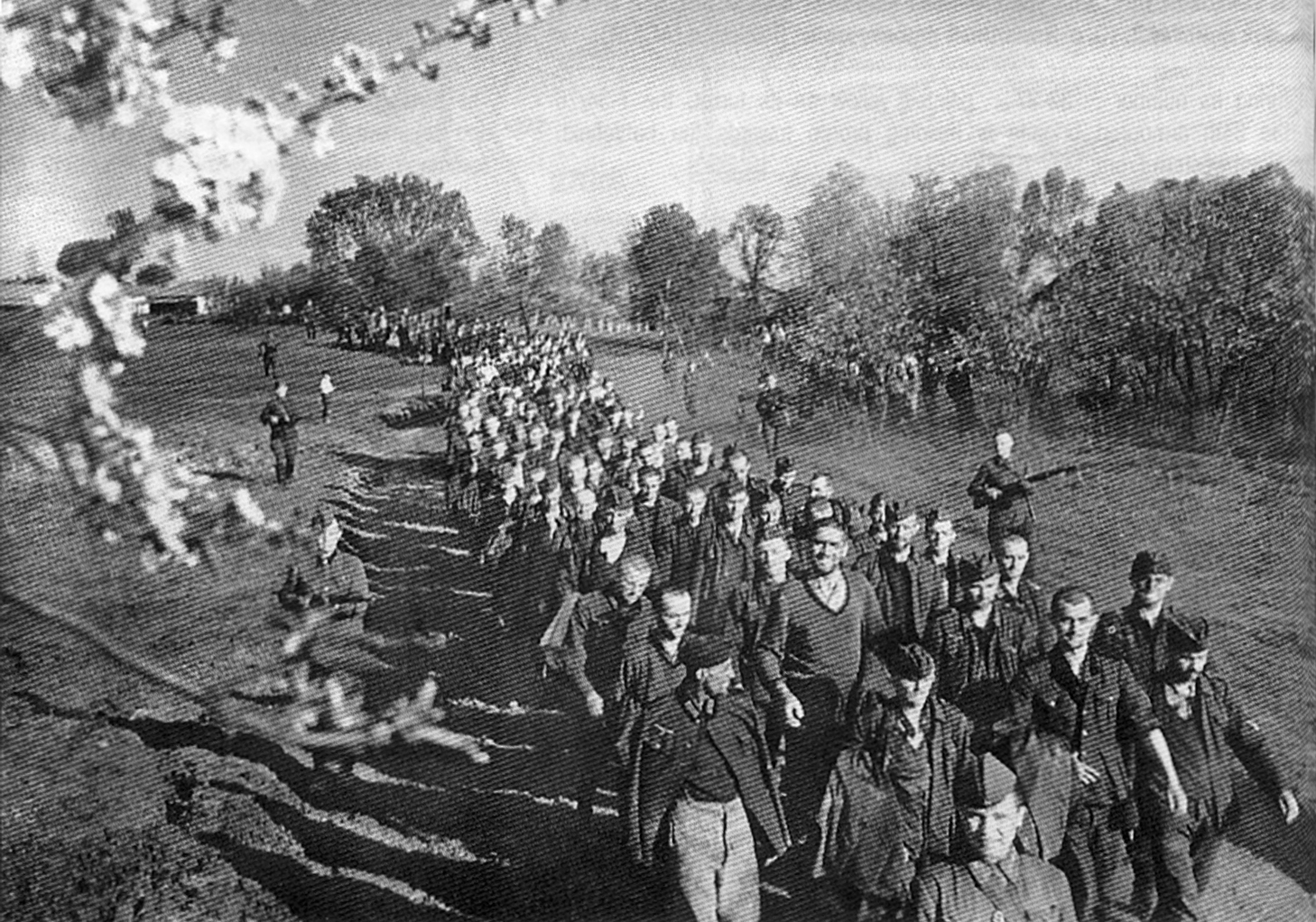
German Prisoners of War in Kharkiv Region
© Andrii Paramonov (Kharkiv).
While working with documents concerning Japanese prisoners of war in Kharkiv region, I could not resist looking through the files containing information about POWs from the Western armies. I wish I had not done so! I am an emotional person, and I perceive such documents as though the events had happened to me personally. My inner conflict lasted only for the first few minutes, after all, these were Germans who had invaded my country and killed several of my ancestors. On the other hand, I could not understand why they had to be kept in our territory. Were there not enough of our own people in the camps? Or was there nothing else to keep political officers busy? The war was over and these men were soldiers following orders. Only a fool could imagine a soldier who had taken an oath refusing to obey the orders of his commanders. The Germans’ treatment of Red Army prisoners of war was obviously far from humane, unlike that of American, British, French soldiers. However, there were reasons for that. Nevertheless, this is no way justifies the actions of the Soviet leadership toward German prisoners of war after the surrender of the Wehrmacht.
German prisoners of war in Kharkiv region were held in several camps and labor battalions. Those placed in Kharkiv were tasked with rebuilding national economy infrastructure. The camp branches outside the town were engaged in road construction or worked on auxiliary farms, where they cultivated vegetables, kept livestock, and gathered firewood for the winter period.
Camp No. 417 is particularly illustrative for understanding the life and daily routine of German prisoners of war. This camp was established on July 27, 1945, for the construction of the Kharkiv – Simferopol Road, with its administration based in Dnipropetrovsk (now Dnipro). A medical unit of the camp was also situated there [1]. All other camp branches were scattered across the Kharkiv region: in the urban-type settlements of Pokotylivka and Merefa, the town of Krasnohrad, and, of course, Kharkiv itself. The personnel of the camp administration and all property, including captured equipment, were transferred from the frontline camp No. 2 in Austria. The majority of the POWs in the camp had served in the SS, SD, gendarmerie, NSDAP, or Hitler Youth. The camp also held soldiers and officers serving long prison sentences for crimes, atrocities, and executions of civilians, including Siegfried Korff (an SS Oberscharführer of the Leibstandarte SS “Adolf Hitler” division) and Werner Keller (a non-commissioned officer of the 256th infantry division), both serving 25-year sentences imposed by court verdicts.
Where to begin? Perhaps with the main point – why these people were brought from Europe, meaning their labor. Yet, they were poorly provided with work. Work orders were issued irregularly, and part of the work was not accounted for at all. For the camp administration, the main goal was to fulfill the production plan. The number of prisoners used for this purpose was of little concern. At the same time, the prisoners of war could not meet their daily quotas and therefore received reduced wages. There was no means of mechanization, tools were scarce, and safety precautions were not observed, which resulted in high numbers of industrial injuries. Numerous work downtimes were caused by shortages of materials, fuel, and transport. As a result, the camp relied on subsidies, which in turn negatively affected the supply of food and household items.
The prisoners of war lived in damp, overcrowded dugouts without light and ventilation. There was a lack of fuel, and the small room for the disinfection unit could not ensure the proper treatment of the prisoners. Scheduled sanitation procedures of the premises were frequently disrupted. The mattresses were old, consisted of piles of rags. There were no blankets, sheets, or towels. Clothing and footwear were neither replaced nor repaired for a long time. The food rations were meager and did not meet official supply standards.
Officers from the camp administration and camp branches conducted regular searches, confiscating the prisoners’ personal belongings: wedding rings, cameras, and warm clothes, especially sweaters. In 1945, administrative officers appropriated captured camp vehicles for their personal use, along with other valuable property. As a result, three officers were sentenced to 3 years (probation!). In 1947, the officers had nothing left to embezzle or confiscate, so they began selling potatoes at the market through their relatives, sold a horse, and the camp commander embezzled 3,000 rubles.
In addition to labor, a daily show of re-education of the Nazis was staged in the form of anti-fascist propaganda. This aspect was considered particularly important. Special departments also operated daily, interrogating prisoners of war and attempting to persuade them to inform on their fellow prisoners. On top of that, the senior leadership of the Ministry of Internal Affairs demanded the introduction of socialist competition between the detachments.
Combined, all of that resulted in the mass deaths of prisoners of war from diphtheria, pneumonia, and other illnesses. Sometimes, dozens of German prisoners died in a single day. The first cemeteries were established spontaneously, but local councils prohibited the burial of prisoners there, and as a result, the graves were leveled to the ground. No identifying markers were placed on the graves, so the first burials from 1945-1946 are not even marked on maps. Consequently, it remains unknown where the burial sites are located at the Sortuvalna station, near the Nova Bavaria station or on the grounds of Kharkiv Tractor Plant. Only the lists of deceased survived. In 1947, the situation regarding burials changed somewhat. The graves began to be marked, separate sections for prisoners of war were allocated in the official cemeteries of Kharkiv, and metal grave markers were installed. However, in 1950, by order of the regional administration of the Ministry of Internal Affairs, more than ten official burial sites across the region were leveled. By the early 1970s, only two official cemeteries with the graves of prisoners of war remained. But they, too, soon vanished.
The sick prisoners of war were sent to special hospitals, one of which represents a rare form of cynicism that provokes a burning hatred for the Soviet regime within me. If the authorities wanted so badly to avenge the deaths of Soviet soldiers and civilians, why not just let them die among their comrades? Why create the illusion of medical care? Special hospital No. 5367 was located in the settlement of Vysokyi, Kharkiv region. It was opened on the basis of an evacuation hospital on January 1, 1945. On that very day, 518 sick German prisoners were transferred there from Stalingrad. Every one of them died! The hospital was housed in six separate buildings designed to accommodate 400-450 patients. The bed linen was old, and the beds were doubled-tiered! The illumination came from kerosene lamps! To heat the buildings, the sick prisoners of war themselves had to uproot tree stumps in the Babai Forestry. There was no sewage system, and the toilets were located outdoors. Running water was available only in some of the buildings.
During the existence of the hospital (it was closed on December 31, 1949) 1,026 people were buried in 703 graves at the cemetery in the Krute tract. Those buried there included German, Hungarian, Polish, Czech, Romanian, and Japanese POWs. During the years of Ukrainian independence, German public organizations relocated this cemetery to Kharkiv Municipal Cemetery No. 17. A memorial marker was erected in the Krute tract of the Babai Forestry, but it was demolished by unknown people that same year. Worse still was the situation at the cemetery of Special Hospital No. 5993 in Barvinkove, where locals turned the burial grounds into vegetable gardens in 1949.
In Camp No. 149, the largest camp in Kharkiv, the mortality rate was also high. Prisoners of war were buried at the Chervonozavodske and Zmiiv cemeteries of Kharkiv, near the Loseve station, at the Sortuvalna station, and in the settlement of Kehychivka. The total number of deceased exceeded 2,000. Separate Labor Battalion No. 1556, which was engaged in the construction of the Kharkiv airfield in the village of Kotliary, buried 284 people in 117 graves by 1948.
The only unit that was more or less decent in terms of the conditions for keeping prisoners of war was Separate Labor Battalion No. 1551, which belonged to the Kharkiv “Promshakhtbud” Trust[2]. It employed 1,500 prisoners of war, mostly Germans. These were mainly Wehrmacht soldiers, and by 1948, the employment rate of each prisoner accounted for 93% of working hours. They restored several residential buildings and factory structures in Kharkiv, receiving an average monthly wage of 14 rubles and 38 kopiyka. The administration noted high achievements not only in labor productivity but also in the re-education of the prisoners of war, most of whom returned to their homeland in November 1949. Six German detachment commanders left behind a photo album with messages of gratitude addressed to the battalion’s leadership. The burial sites of this battalion were located in the official Kharkiv cemeteries with identifying markers, but they were destroyed in the 1970s. However, the burial locations for Separate Labor Battalions Nos. 1552, 1554, and 1557, where German prisoners of war also predominantly worked, remain unknown. These were disbanded due to poor performance against labor quotas, combined with high mortality rates. By 1949, none of the personnel from the administration knew the locations of these burial sites remained, as they had been dismissed from the MIA for various violations.
In December 2013, I traveled around several sites where German prisoners of war had been held and buried. I simply could not resist the urge to see them. It brought no relief! Today, I plan to publish the lists of deceased prisoners of war of all nationalities buried in the Kharkiv region. Fewer than half of them will have an exact burial location. Yet even these graves have now been leveled to the ground or built over. I am sincerely sorry that the descendants of these servicemen who were destroyed by the Soviet regime even after the end of the Second World War will have to bow their heads not at an official burial site, but in public areas: over graves where residents of Kharkiv, Izium, Chuhuiv, and Kupiansk were later buried, on factory grounds, highways, wastelands, and scrapheaps!
[1] RSVIA (Russian State Military Historical Archive). – F. 1p, op. 15 a, d. 319. Formular of Camp No. 417.
[2] RSVIA. – F. 145p, op. 15, d. 1. Report on the activities of ORB No. 1551 from January 1945 to November 1949.